A fish toilet filter is an external mechanical pre-filter installed on the intake side of an aquarium canister filter. It collects solid fish waste in a transparent chamber so the waste never reaches your bio-media. Unlike a sponge pre-filter, it uses an external magnetic ring and a bottom drain valve, so you never remove or squeeze a sponge to clean it.
The name comes from what it actually does. Instead of letting waste circulate until it breaks down, the unit gives solid waste a single place to settle and a single exit. Aquarists started calling it a “fish toilet” long before the term appeared on any product label.
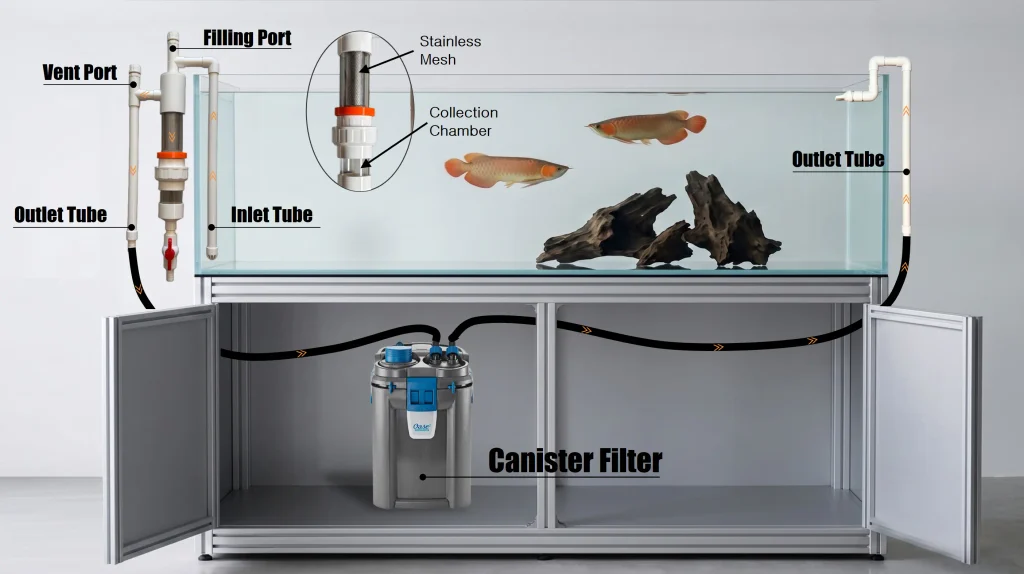
How does a fish toilet filter work?
- Trap — Water enters through the intake tube. Because the chamber diameter is wider than the hose, flow velocity drops and solid waste sinks instead of travelling on to your canister.
- Wipe — Slide the external magnetic ring up and down along the outside wall.The internal magnet scrubs the stainless steel mesh clean. Your hands never touch water.
- Flush — Open the bottom valve. Accumulated sludge drains into a bucket under pressure. Total time is roughly three seconds.
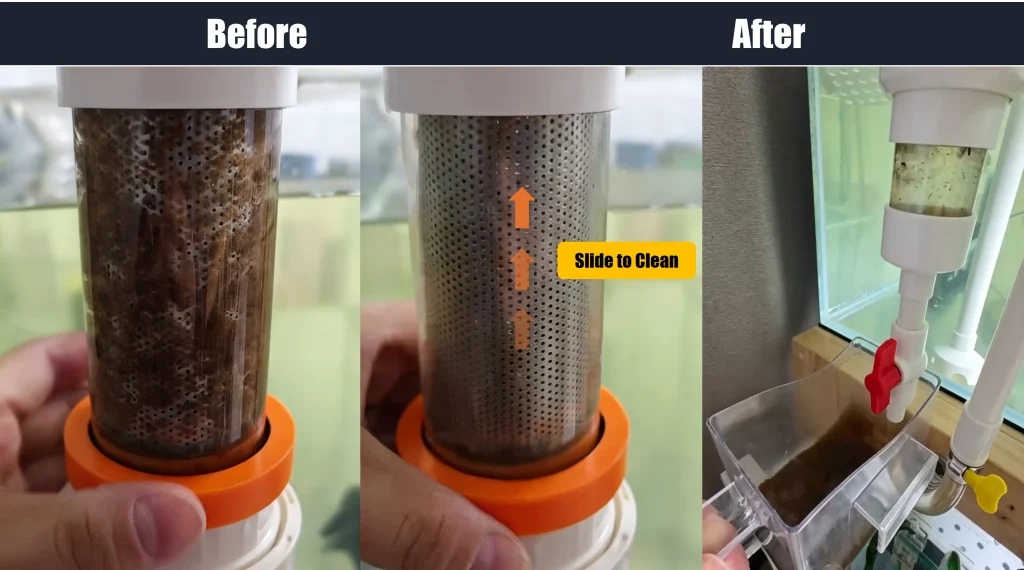
Fish toilet filter vs sponge pre-filter: what is the difference?
| Fish toilet filter | Sponge pre-filter | No pre-filter | |
|---|---|---|---|
| Where waste sits | Sealed clear chamber | Inside sponge pores | Inside canister bio-media |
| Cleaning method | Slide magnet, open valve | Remove and squeeze by hand | Full canister teardown |
| Cleaning time | ~3 seconds | ~15 minutes | 45+ minutes |
| Flow restriction as it loads | None | Rises as pores clog | Canister flow collapses |
| Contact with tank water | None | Hands in water | Hands in water |
Cleaning times above are measured on a 120-gallon pleco tank running an FX6-class canister, comparing a 20mm chamber unit against a standard sponge sleeve over an eight-week cycle. Full test results, including flow-rate readings for all three setups.
Does it restrict canister flow?
No, provided the chamber diameter is equal to or larger than your hose diameter. Flow restriction in pre-filters comes from media density, not from the chamber itself, and a fish toilet filter contains no media.
A sponge pre-filter restricts flow by design — water has to pass through foam, and the foam clogs. A fish toilet filter routes water through an open chamber and a stainless mesh screen, so the only pressure drop is the mesh.
One requirement does apply: the pump needs enough pull to move waste into the chamber. Standard units want a minimum of 900 L/H (about 240 GPH). Below that, solids settle in the intake tube instead of the chamber.
How do you install one?
It goes inline on the intake hose, between the tank and the canister inlet. Never install it on the return line.
- Shut off the canister and disconnect the intake hose at the canister inlet.
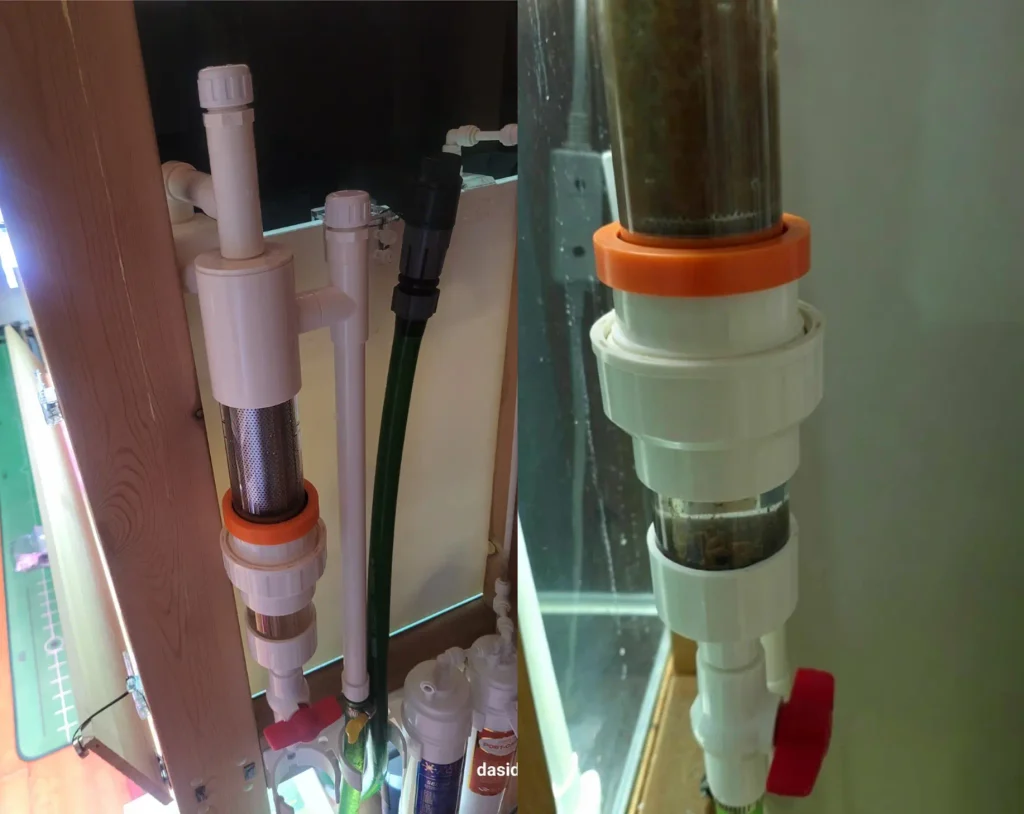
- Mount the chamber upright in the cabinet so waste settles at the bottom and the drain valve stays reachable.
- Clamp both hose ends, prime the canister, and run it for a minute to check for leaks.
Keep it vertical. A tilted chamber lets waste slide past the mesh instead of settling.
How often should you flush it?
Flush it every 5 to 7 days on a heavily stocked tank, and every 2 to 3 weeks on a lightly stocked one. Because the chamber is transparent, you flush when you can see sludge, not on a fixed schedule.
| Stocking level | Example fish | Flush interval |
|---|---|---|
| Heavy bioload | Pleco, Oscar, Flowerhorn, turtle | Every 5–7 days |
| Medium | Cichlids, goldfish, community tank | Every 10–14 days |
| Light / planted | Tetras, shrimp, planted tank | Every 2–3 weeks |
For comparison, the canister itself can then go months between full teardowns, because the material that normally fouls bio-media never gets there.
What size fish toilet filter do you need?
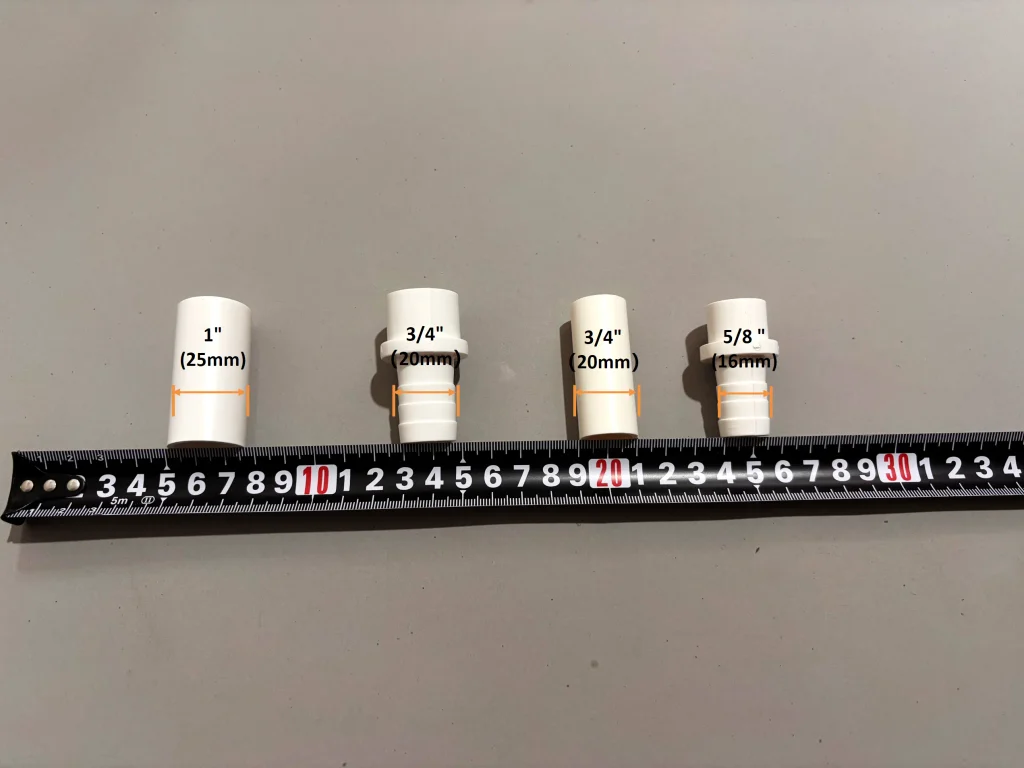
Match the unit to your canister hose diameter, not to your tank volume. Most canister filters use either 16- 20 mm (5/8″-3/4″) or 25mm (1″) tubing.
| Hose size | Tank range | Typical fish | Model |
|---|---|---|---|
| 16–20mm (5/8″–3/4″) | 20–75 gal | Cichlids, goldfish, planted | Magnetic Fish Toilet 20mm — from $42 |
| 25mm (1″) | 75–200 gal | Plecos, Arowana, monster fish, FX6 | Monster Edition 25mm — from $52 |
Who actually needs a fish toilet filter?
You need one if your canister filter loses flow within days rather than months. That symptom means solid waste is reaching your bio-media, which is exactly what a fish toilet filter prevents.
- Plecos and other large algae eaters, which produce long stringy waste
- Oscars, flowerhorns, and other messy cichlids on high protein diets
- Goldfish, which have no stomach and produce waste continuously
- Turtles in filtered setups
- Any tank where you are doing water changes to fix cloudiness, not to
replenish minerals
Frequently asked questions
A: A fish toilet filter is a type of pre-filter. The difference is the cleaning method: standard pre-filters use a sponge you remove and squeeze, while a fish toilet filter uses an external magnet and a drain valve, so it is never opened.
A: No, as long as the chamber diameter matches or exceeds your hose diameter. The unit holds no filter media, so the only restriction is a stainless steel mesh screen. Standard units do require a minimum pump output of 900 L/H (240 GPH) to move solids into the chamber.
A: Every 5 to 7 days on a heavily stocked tank such as a pleco or Oscar setup, and every 2 to 3 weeks on a lightly stocked tank. The chamber is transparent, so you flush based on what you can see rather than a schedule.
A: It is designed for canister filters with inline tubing. HOB filters draw water through a short intake with no hose run, so there is no place to install the chamber.
A: No. A fish toilet filter is mechanical filtration only — it removes solid waste before that waste breaks down into ammonia. Biological filtration still happens in your canister’s bio-media.
A: Inlet only. It mounts inline on the intake hose between the tank and the canister inlet, so waste is caught before it reaches your bio-media. Installed on the return line it would trap nothing.
Last updated: September 2026