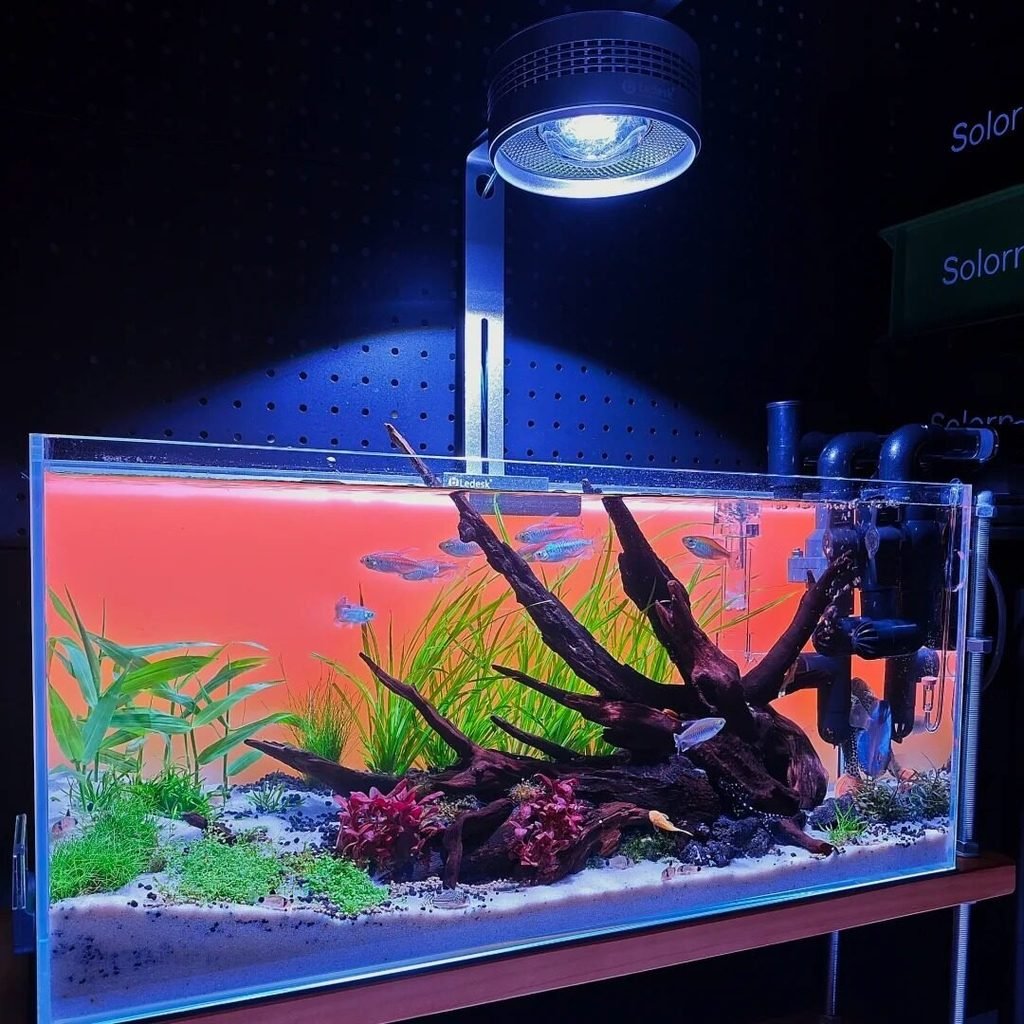
Choosing the best aquarium light for planted tanks comes down to two numbers: your tank length and your plants’ light demand. Get those two right and almost any full-spectrum fixture will grow plants. Get them wrong and even a $120 light will fail — stretched stems, melting leaves and algae instead of a lush carpet.
This guide compares the four full-spectrum LEDs we stock, from a $14.99 USB nano light up to an 80W high-output fixture, with every size variant, wattage and price in one table. We also cover how light demand is actually classified, how to position and time your fixture, and the one water parameter that quietly destroys PAR.
Quick Answer: Which Is the Best Aquarium Light for Planted Tanks?
Quick answer (2026): Match tank length first, then plant demand.
- Tanks up to 20″ with low-light plants (java fern, anubias, moss, cryptocoryne) → USB Aquarium LED Light, $14.99–$22.99.
- 20–24″ tanks with stem plants and swords → Full Spectrum Aquarium LED Light, $23.99–$29.99.
- Carpeting species, red-stem plants, or tanks deeper than 18″ → Full Spectrum Aquarium Light (High-Output), 55W–80W, $110–$120.
- Accent lighting on a rimless or nano tank → Zoomable Aquarium Clip-on Spotlight, $16–$27.
One rule worth keeping: buy for the tank you have today, not the tank you plan to upgrade to next year. A fixture that is slightly too bright can be dimmed or raised. A fixture that is too dim leaves you buying a second light within a season.
Light demand explained: low, medium and high
“Low”, “medium” and “high” light are not marketing labels — they describe how much photosynthetically active radiation (PAR) reaches the substrate, and they map onto specific groups of plants. PAR is the slice of the spectrum plants actually use for photosynthesis; the technical definition is on Wikipedia, but for buying decisions the plant list below matters far more than the number.
- Low light — java fern, anubias, cryptocoryne, bucephalandra, java moss. These photosynthesise slowly, tolerate dim corners and shaded hardscape, and are the safest choice for a first planted tank.
- Medium light — most stem plants (rotala, ludwigia, hygrophila), amazon swords, dwarf sagittaria, vallisneria. This is the sweet spot for a colourful, bushy aquascape without demanding CO2.
- High light — carpeting plants (monte carlo, dwarf hairgrass, glosso) and red-stem species (alternanthera reineckii, rotala macrandra). In practice these need injected CO2 and regular fertilisation; light alone will not carpet a tank.
Getting the level wrong produces very different symptoms. Under-lit plants etiolate — stems stretch toward the light, internodes lengthen, lower leaves drop and the tank looks leggy within weeks. Over-lit tanks without matching CO2 and nutrients grow algae instead: green dust on the glass, staghorn on hardscape, and black beard on slow-growing leaves. If you are between two levels on a new tank, start at the lower one and add hours gradually.
Comparing the Best Aquarium Lights for Planted Tanks (Specs & Prices)
Below is every fixture we stock, with all size variants, wattage, light level and USD price. Find your fixture in the LED Model column, then pick the row whose tank length matches yours. All four are full-spectrum and rated for freshwater planted tanks.
| LED Model | Size / Variant | Wattage | Light Level | Price (US) |
|---|---|---|---|---|
|
USB Aquarium LED Light Full spectrum · USB-powered, nano & small tanks View details → | 7″-12″ (18-31cm) | 5W | Low | $14.99 |
| 11″-16″ (28-41cm) | 8W | Low-Medium | $18.99 | |
| 15″-20″ (38-51cm) | 9W | Medium | $22.99 | |
| 19″-24″ (48-61cm) | 10W | Medium | $28.99 | |
| 23″-28″ (58-71cm) | 10W | Medium | $40.99 | |
|
Full Spectrum Aquarium LED Light Full spectrum · US & EU plug, same price View details → | 7″-12″ (18-31cm) | 8W | Low-Medium | $15.99 |
| 11″-16″ (28-41cm) | 12W | Medium | $19.99 | |
| 15″-20″ (38-51cm) | 16W | Medium-High | $23.99 | |
| 19″-24″ (48-61cm) | 20W | High | $29.99 | |
|
Zoomable Aquarium Clip-on Spotlight COB spot · 3 colors, 9 dimming levels, 360° clamp View details → | Clip-on spot (zoomable) | 3W | Low (spot) | $16.00 |
| Clip-on spot (zoomable) | 4.2W | Low-Medium | $21.00 | |
| Clip-on spot (zoomable) | 6.2W | Medium | $23.00 | |
| Clip-on spot (zoomable) | 8.2W | Medium-High | $25.00 | |
| Clip-on spot (zoomable) | 10.2W | High | $27.00 | |
|
Full Spectrum Aquarium Light (High-Output) 95Ra CRI · 160° lens · US plug includes 110V-220V transformer, EU plug from $75 View details → | High-output fixture | 35W | Medium | $105.00 |
| High-output fixture | 55W | High | $110.00 | |
| High-output fixture | 80W | High | $120.00 |
Spotlight wattages are zoom-adjustable — choose by plant density rather than tank length. All prices in USD; EU-plug pricing for the high-output fixture is shown on its product page.
1. USB Aquarium LED Light ($14.99 – $40.99) — Best for Nano & Desktop Tanks
The entry point, and genuinely the right answer for nano and small tanks. Five sizes from 7″ to 28″, drawing 5W to 10W from a USB source, so it runs off a phone charger or a USB hub with no spare outlet needed. Output is rated Low to Medium, which covers java fern, anubias, cryptocoryne and moss comfortably. It will not carpet a 20″ tank, and nobody should expect it to at this price. Best for: 1–10 gallon nano tanks, desktop aquariums, quarantine setups, and shrimp tanks where heat load matters.
2. Full Spectrum Aquarium LED Light ($15.99 – $29.99) — Best Budget Pick for Beginners
The mid-range workhorse and the fixture we recommend most often. Four sizes from 7″ to 24″, drawing 8W to 20W from a standard outlet, with US and EU plugs at the same price. Output steps from Low-Medium up to High, so a 16W unit will carry most stem plants and swords without CO2 injection. Best for: 10–40 gallon community planted tanks, first-time planted-tank keepers, and anyone who wants one fixture that covers most plant choices.
3. Zoomable Aquarium Clip-on Spotlight ($16 – $27) — Best for Rimless & Deep Scapes
Different in kind, not just in price. A COB spot rather than a bar: three colour temperatures, nine dimming levels, and a zoomable lens that narrows the beam for deep tanks or widens it for shallow ones. The 360° clamp fits rimless glass and awkward tank geometries where a bar would overhang. Because it is a spot, choose by plant density rather than tank length — a 10.2W unit beamed into a 12″ nano delivers very high intensity. Best for: nano tanks, hardscape accent lighting, and tanks where a full bar would look oversized.
4. Full Spectrum Aquarium Light, High-Output ($105 – $120) — Best for High-Tech & Carpeting Plants
The serious fixture. 35W, 55W and 80W variants with 95Ra colour rendering and a 160° lens that pushes light into the corners rather than straight down. The US version ships with a 110V–220V transformer; the EU plug version starts at $75. At 55W and above you are in territory where carpeting species and red-stem plants become realistic — but only alongside CO2 injection and consistent fertilisation. Best for: 20 gallons and up, high-tech tanks, deep tanks over 18″, and keepers who have already outgrown a bar light.
Two notes on reading the table. The spotlight wattages are zoom-adjustable, so choose those by plant density rather than tank length. And if you are torn between two rows, take the brighter fixture: dimming is built in, and most “high-light” units ship with a dimmer, while a dim light cannot be made brighter.
For context on price: budget clip-on brands such as NICREW and hygger typically sit in the $20–$40 range for basic 20–30W fixtures, while premium names like Chihiros, Finnex and Kessil start above $100. Our range ($14.99–$120) is positioned between those two ends — full-spectrum output and dimming at mid-range pricing. Where a competitor fixture is genuinely the better buy for your setup, we would rather say so than push our own.
How to position and run your light
Buying the right fixture is half the job. These are the settings that decide whether it grows plants or algae. The planted-tank lighting references at Aquarium Science and Tropical Fish Hobbyist are worth bookmarking if you want to go deeper on photoperiod and intensity.
- Height. 6–10″ above the water line suits most fixtures. Raise it if you see surface glare or bleaching on leaf tips; lower it only if the substrate is visibly dim.
- Spread. Check the rated length against your tank. A fixture rated for 20″ will leave dark corners on a 29″ tank — two smaller fixtures beat one long fixture in that case.
- Photoperiod. Run 6–8 hours on a timer. More hours does not mean more growth; past roughly 8 hours you are mainly growing algae, because CO2 depletes long before the light does.
- Acclimation. Start a new tank at 6 hours and add 30 minutes per week. This gives plants time to outgrow the algae that colonise any new setup.
- Clean the lens. A film of algae and mineral scale on the acrylic measurably cuts output. Wipe it during water changes — it is the cheapest upgrade available.
- Keep it dimmable. Dimmable fixtures let you correct for CO2 levels, plant density and algae pressure without buying new hardware.
A last word on algae. In a planted tank, a bloom is almost always a light / CO2 / nutrient imbalance rather than a fixture that is “too strong”. Before replacing hardware, cut the photoperiod by two hours for a week and check your CO2 and fertiliser dosing. Nine times out of ten the algae recedes.
Three mistakes we see more often than any other, all of them cheap to avoid:
- Buying on wattage alone. Wattage tells you power draw and heat, not intensity at the substrate. A 20W bar with a good lens out-lights a 35W bar with a poor one. Compare light level and rated tank length instead.
- Ignoring the rated length. A 20″ fixture on a 29″ tank leaves a dark band at each end, and plants there will melt while the middle carpets. Measure before you order.
- Running the light 10–12 hours. The most common cause of a new-tank algae bloom. Six to eight hours, on a timer, every single day.
Does water clarity affect your light’s PAR?
Yes — and this is the part most lighting guides skip. Water is not perfectly transparent to light. Dissolved organic compounds, tannins leaching from driftwood, fine suspended debris and micro-algae all scatter and absorb photons before they reach your plants. PAR therefore falls measurably as clarity drops: a fixture that delivers strong PAR in crystal-clear water can under-light the same tank once the water has gone hazy or yellow. Effective filtration is part of your lighting setup, not a separate hobby.
💡 Pro Tip from the A&Aqua Pro Lab: Why even a $120 high-output light fails in cloudy water: Water clarity dictates usable PAR.
That is why we build inline pre-filters. A magnetic fish toilet pre-filter traps solid waste in an external chamber before it dissolves into the water column, so the light you paid for actually reaches the substrate. The 25mm Monster edition suits high-flow canister lines. If you are comparing filtration options rather than lighting, our top 3 pre-filters for 2026 breakdown covers the trade-offs, and the fish waste myth guide explains why mechanical removal beats clean-up crews.
Investing in the best aquarium light for planted tanks is only half the battle. To ensure those photons actually reach your carpet plants, your water must be crystal clear.
Frequently asked questions
he rule of thumb is to match the fixture’s output to your most demanding plant. For low-light species like Anubias or Java Fern, a basic low-wattage LED is sufficient. However, if you are growing carpeting plants or red stem species, you will need a high-output fixture paired with CO2 injection. When shopping for the best aquarium light for planted tanks, always check the PAR rating rather than just the wattage.
Absolutely. Unlike traditional sponge filters or wet/dry sumps that cause surface agitation and off-gas your precious CO2, the A&Aqua Pro magnetic pre-filter is a completely sealed inline system. It removes solid waste instantly without affecting your CO2 saturation levels.
Yes. BBA and other nuisance algae thrive in high-light environments when there is an excess of dissolved organic waste. By trapping and removing dead plant melt and fish poop before it rots, you starve the algae of nutrients while allowing your plants to utilise the light fully.
Six to eight hours, on a timer. Plants only photosynthesise while CO2 is available in the water column, and in a non-injected tank that supply is largely exhausted after about six hours. Extending the photoperiod beyond eight hours mostly grows algae rather than plants. Start a new tank at six hours and increase by 30 minutes per week as the plant mass fills in.
Not necessarily, but high-light plants become far more demanding once CO2 is added. With injection you can run carpeting and red-stem species that would otherwise melt, and those species do need the higher output of a 55W-80W fixture or a merged spotlight array. If you keep low and medium-light plants, a mid-range full-spectrum LED remains sufficient even with CO2 running.
Yes, if you place them deliberately. Put anubias, java fern and cryptocoryne in the shaded zone under hardscape or at the tank’s far end, and reserve the brightest spot directly under the fixture for stem plants and carpets. A dimmable fixture makes this much easier, because you can lift intensity in the bright zone without bleaching the shade-lovers.
While planted tanks rely on pristine lighting, heavy bioload setups play by entirely different rules. If you’ve graduated from delicate aquascapes to massive predators…
🏗️ Running Multiple Monster Tanks or Koi Ponds?
We are currently engineering heavy-duty modular pre-filters for commercial setups and monster fish keepers.
Upcoming sizes: 1.25″ (32mm) · 1.5″ (40mm) · 2.5″ (63mm)
Let us know your specific tank volume and hose size requirements.
I have been struggling with my high-tech carpet plants for months because I could never get the water clarity right despite running a top-tier LED fixture, but this article really hit home regarding how suspended particles block light penetration; the idea of using a sponge-less system to prevent flow restriction while keeping the water pristine is genius, so I was wondering if this Magnetic Fish Toilet Pre-Filter is compatible with the standard 16/22mm hoses I have on my canister filter and if the flush mechanism is truly as simple as advertised for someone living in the US?
Hello Elizabeth, we are thrilled that our system can help with your carpet plant clarity; it is fully compatible with your 16/22mm hoses and the flush mechanism is indeed a simple, hands-free 3-second process. We ship to the US within 6-12 days and look forward to helping you achieve that crystal clear water.