A bar light floods a tank; an aquarium clip-on spotlight sculpts it. The difference is not brightness, it is control: a zoomable lens pushes the same watts into the patch of tank you actually want to look at — a piece of driftwood, a Bucephalandra clump, a betta’s fins — and leaves the rest in shadow. That contrast is what makes a small tank read as deep instead of flat. Below: seven ways aquascapers use a focused beam, what the zoom lens really changes, and when a bar light is still the right call.
In this guide
- Where HOB noise actually comes from — the waterfall, not the motor
- 3 fixes you can do in 10 minutes on the filter you already own
- What 35 dB sounds like, and which model fits your tank
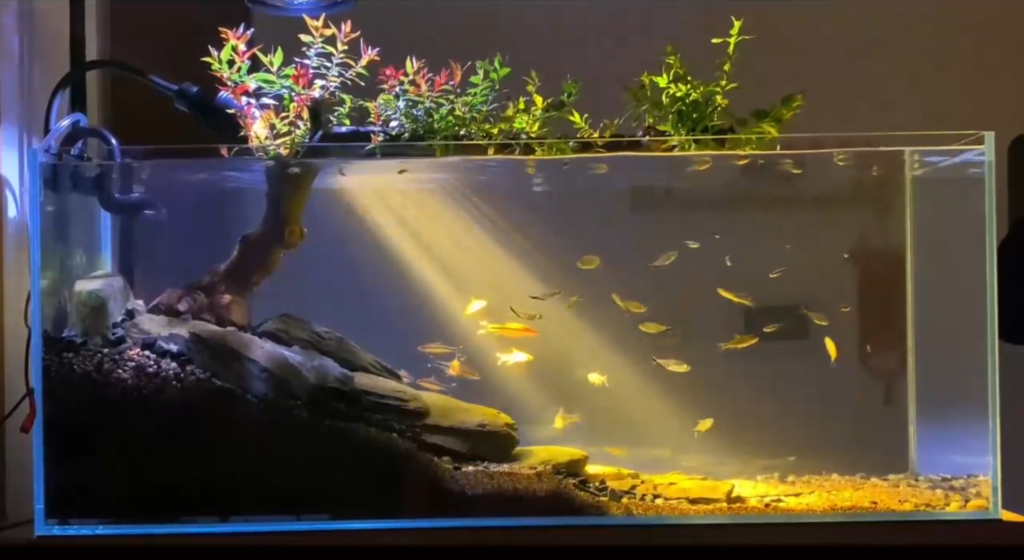
What an aquarium clip-on spotlight does that a bar light can’t
A bar light has one job: deliver even coverage top to bottom. That is exactly what you want for a carpet that has to grow uniformly, and exactly what you do not want when you are trying to make a thirty-centimetre tank look like a landscape.
A spotlight adds three things a bar cannot:
- Contrast. Light falling off at the edges is what creates the sense of depth in a scape. Even lighting flattens it.
- A focal point. One bright patch tells the eye where to look. Aquascaping competitions are won on focal points, not on brightness.
- Algae management by geometry. Instead of running the whole tank at high intensity for eight hours, you can run a bright patch for a few hours and leave the rest of the tank dim, which keeps total light pressure lower.
7 ways aquascapers use a zoomable spotlight
1. Make one piece of hardscape the focal point
Narrow the beam until it just covers your driftwood or your main stone, and everything else drops into shadow. This is the cheapest change you can make to a scape — no new plants, no new hardscape, just light placement.
2. Push light down to carpets and low-light plants
Anubias, Bucephalandra, and Cryptocoryne sit at the bottom where a bar light has already lost most of its intensity. A focused beam from above delivers usable light at substrate level without raising the whole tank’s intensity.
3. Warm night mode for bettas, shrimp, and evening viewing
Switch to the warm 2700K channel after the main light goes off. Shrimp stay active under warm, dim light, bettas show deeper reds and blues, and the tank stays viewable without running a full white spectrum until bedtime.
4. Light a rimless nano or desk tank without glare
A bar light over a small rimless tank throws light onto the glass and onto everything behind it. A clip-on spotlight angled down and slightly forward lights the scape and nothing else — which matters when the tank sits next to a monitor.
5. Shoot better photos and video
Phone cameras expose for the brightest thing in frame, so a uniformly lit tank either blows out the highlight or darkens the fish. Aim an aquarium clip-on spotlight at the subject and shoot — you get shimmer lines on the hardscape, separation between subject and background, and no blown highlights.
6. Quarantine, hospital, and fry tanks
A hospital tank does not need a photoperiod, it needs enough light to observe a fish for five minutes. A clip-on light gives you that, packs away when the tank does, and costs a fraction of a second fixture you will rarely use.
7. Spotlight a show fish or a shrimp colony
Keep the tank dim and light one corner where the colony grazes. Shrimp gather in the lit patch, the rest of the tank stays calm, and you get a viewing window without running the full tank at display intensity all day.
Why an aquarium clip-on spotlight beats a bigger bar (in one spot)
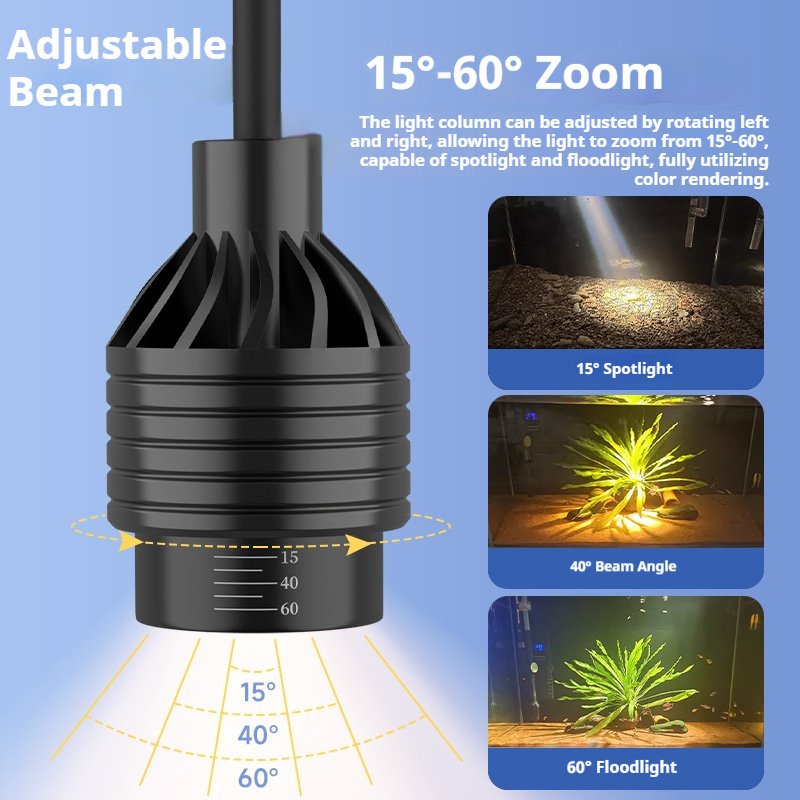
Zoom does not add light, it moves light. The same emitter concentrated into a smaller circle raises intensity at the target without raising wattage, heat, or your electricity bill — which is why a 3W zoomable unit can make a Bucephalandra clump look brighter than a 20W bar running the whole tank.
Two mechanisms are in play, and both matter:
- Beam angle. Narrow the beam and the same lumens land on less surface area, so the lit patch gets more of them.
- Working distance. A clip-on light sits closer to the scape than a suspended bar, and intensity falls off with distance. Halving the distance is worth more than doubling the watts.
The catch is duration: a tight beam parked on one spot for twelve hours a day will grow algae on that spot like any other intense light. Focus, enjoy it for a few hours, then widen the beam or drop a dimming level.
How the zoom works on this unit: the 3W model uses a push-pull zoom; the larger models use a smooth rotary zoom.
6500K or 2700K — and how long to run it
The COB dual-colour system gives you two channels and three modes:
| Mode | Colour | Best for |
|---|---|---|
| White | 6500K | Plant growth, true colours, photography, daytime viewing |
| Warm | 2700K | Evening viewing, betta and shrimp colour, calmer look |
| Mixed | Both | General display with a natural sunlight feel |
Nine dimming levels and a built-in 3 / 9 / 12-hour timer mean the light can run a consistent photoperiod without a separate timer plug — and a consistent photoperiod does more for algae control than any intensity setting.
Spotlight or bar light?
| Your tank | Choose |
|---|---|
| Rimless nano or desk tank (≤ 30 cm) | Clip-on spotlight |
| Scape with a clear focal point | Spotlight on the focal point, bar for the rest |
| Dense carpet that must grow evenly | Bar light |
| Tall tank (≥ 50 cm) | Bar light — a clip-on cannot reach the bottom evenly |
| Hospital / quarantine / fry tank | Clip-on spotlight |
| Photography and video | Spotlight as a key light, bar as fill |
Which aquarium clip-on spotlight size fits your tank
| Model | Fits tanks up to |
|---|---|
| 3W | 11.8 in (30 cm) |
| 4.2W | 21.6 in (55 cm) |
| 6.2W | 25.5 in (65 cm) |
| 8.2W | 33.4 in (85 cm) |
| 10.2W | 37.4 in (95 cm) |
The honest rule: choose an aquarium clip-on spotlight when contrast matters, and choose the bar when uniformity matters. Most real tanks end up wanting both — a bar for the photoperiod, a spotlight for the evening show.
★ 4.6/5 from 14 verified buyers — the best-reviewed light in our store. Free worldwide shipping, ships in 24-48h.
All models: 360° rotating head, clamp fits rimless and most rimmed tanks up to 0.8 in (20 mm), DC 5V USB power, 9 dimming levels, 3/9/12H timer.
→ More on lighting a planted tank: Aquarium Lights: Illuminating Your Underwater World
Frequently asked questions
A: For low-light plants — Anubias, Bucephalandra, Cryptocoryne, mosses — yes, a zoomable spotlight in the 3–6W range is enough. For a carpeting plant like dwarf hairgrass that has to grow evenly across the substrate, you want a bar light for even coverage.
A: Not necessarily. A spotlight alone works on rimless nano tanks, quarantine tanks, and scapes built around one focal point. A bar becomes necessary when the whole substrate has to receive even light, or when the tank is taller than about 50 cm.
A: Focused light does not cause algae — duration and imbalance do. A tight beam left on one spot for twelve hours will grow algae there, exactly as an overpowered bar would. Run the focused beam 4–6 hours and use the timer.
A: Six to eight hours on a consistent schedule. Consistency matters more than the exact number — a tank lit for 7 hours at the same time every day grows less algae than one lit for 5 hours on an irregular schedule. The built-in 3/9/12H timer handles this automatically.
A: Yes, and it is the usual setup on tanks over 40 cm: one spotlight for the hardscape focal point, one for the planting pocket on the opposite side. Two beams at 50% intensity give more control than one beam at 100%.
A: 2700K warm brings out reds and oranges and keeps shrimp active during evening viewing; 6500K white gives true colours for photography and better plant growth. Run white during the photoperiod and switch to warm for the last hour before lights out.
Lighting a nano tank is a lighting problem, not a wattage problem
Most small tanks are not under-lit, they are evenly lit — which is why they look flat. One zoomable beam, one focal point, and a consistent six-hour photoperiod will do more for a nano tank than doubling the watts.